
Europe’s Champions of Disability Exclusion Revealed
For many people with disabilities across the European Union, life can feel like a postcode lottery – with experiences varying greatly depending on where they live. It is not simply a question of whether someone resides in a city or rural area, but also the country itself that plays a major role in shaping their daily realities.
The European Union’s statistics agency, Eurostat, works with member states to collect and analyse data about the lives of persons with disabilities, enabling comparisons between countries on key issues affecting this community.
Poverty and Social Exclusion
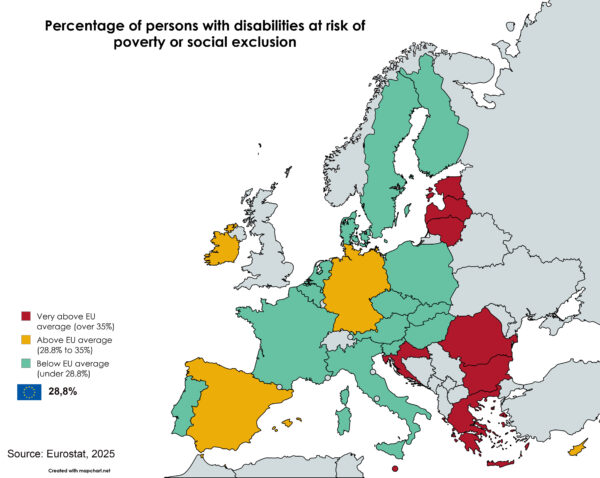
Across the EU, 28.8% of persons with disabilities aged 16 and over are at risk of poverty or social exclusion. However, some countries face significantly more severe challenges.
The countries with the highest proportion of persons with disabilities at risk are:
- Lithuania: 50.5% (compared with 21.9% of persons without disabilities)
- Latvia: 42.6% (18.1% without disabilities)
- Bulgaria: 42.3% (26.6% without disabilities)
- Croatia: 39.8% (15.6% without disabilities)
- Romania: 37% (23.2% without disabilities)
A map comparing these figures across EU countries is available from Eurostat, alongside full poverty statistics.
Inability to Make Ends Meet
On average, 9.1% of people with disabilities across the EU report difficulty in covering necessary expenses such as bills and basic needs. Certain Member States face considerably higher rates:
- Greece: 46.3% (32.3% for persons without disabilities)
- Bulgaria: 19.4% (9.7% without disabilities)
- Portugal: 13.9% (6.7% without disabilities)
- Romania: 13.8% (7.6% without disabilities)
- Spain: 12.4% (6.9% without disabilities)
A detailed breakdown of these statistics and a comparison map offer further insight.
Unmet Health Needs
Health access remains a pressing issue with 4.8% of persons with disabilities in the EU reporting unmet health needs, over three times the rate of those without disabilities (1.6%). The worst-performing countries in this regard include:
- Greece: 32.9% (6.9% for persons without disabilities)
- Finland: 14.7% (4%)
- Latvia: 14.1% (4%)
- Estonia: 12.9% (5%)
- Romania: 9% (1.3%)
More detailed data and a comparison map of unmet health needs are available for review from Eurostat.
Early School Leaving Among Young People with Disabilities
Educational outcomes remain an area of concern. In 2024, 24.8% of young people with disabilities aged 18 to 24 reported leaving school before completing compulsory education. This contrasts sharply with just 8% of their non-disabled peers.
The highest rates of early school leaving among persons with disabilities were found in:
- Romania: 61.6% (16.1% for learners without disabilities)
- Greece: 58.8% (1.2%)
- Bulgaria: 54.3% (8%)
- Lithuania: 42.5% (6%)
- Hungary: 41.2% (9.5%)
Eurostat provides a detailed map comparing early school leaving rates across the EU. The disparities highlight the urgent need for inclusive education policies and supports.
Looking Ahead
This analysis underscores the considerable challenges persons with disabilities continue to face throughout the EU in terms of poverty, healthcare access, and education. Addressing these issues remains critical to ensuring equality and inclusion.
For more information or to explore the full data sets, please visit the Eurostat website.
Original source: Read the original article.