
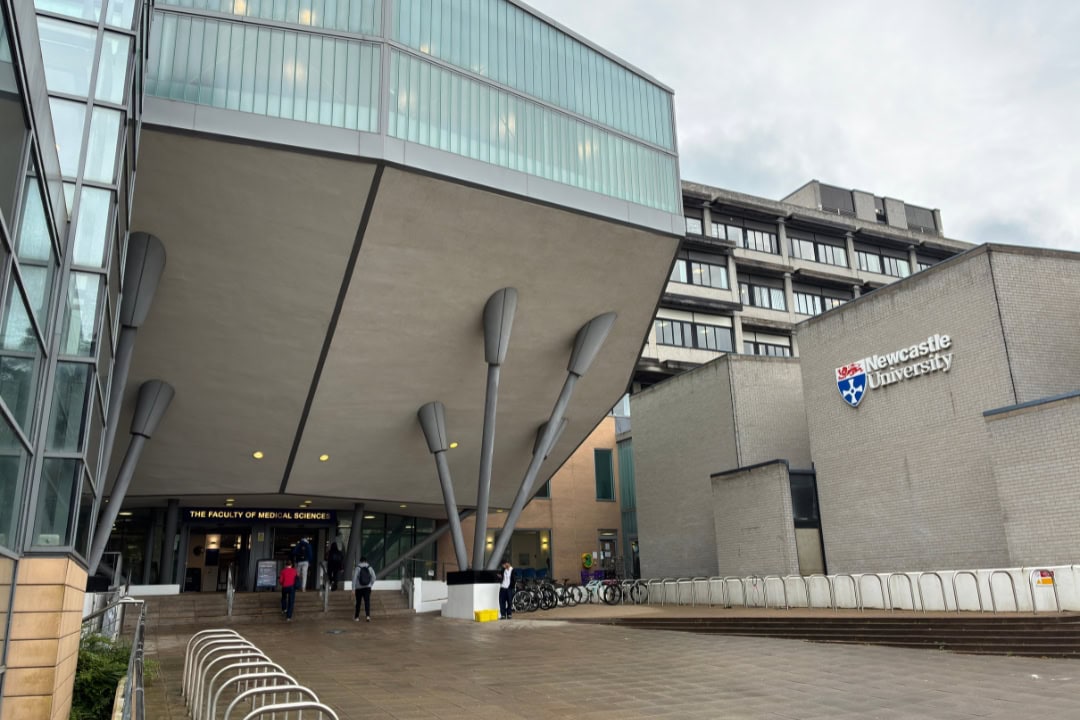
This summer, RNID partnered once again with In2scienceUK to support four student research placements in hearing research laboratories at University College London and Newcastle University. One of the students, Daniel Cairns, spent his placement in Dr Michael Mather’s lab at Newcastle University, where he explored research into the immunology of the nose and middle ear. We caught up with Daniel to learn how the experience influenced his interest in hearing research.
A New Interest in Hearing Research
Before his placement, hearing research was not on Daniel’s radar. “Honestly, no! It wasn’t on my radar before this summer,” he says. However, he explains that he is drawn to research areas that often lack sufficient support, and hearing research is a clear example of this. “It’s a well-recognised, underfunded field. I like working where I feel I can make a difference.”
What the Placement Involved
During his placement, Daniel applied his coding and data analysis skills, alongside his background in medical writing, particularly in manuscript review. He worked closely with Dr Mather on two papers at very different stages: one focused on otitis media (middle ear infection) and the other on models of inner ear organoid development. “There was no real typical day; though it was always lovely to be in the office with such a dedicated and passionate team! I would honestly say my best group research experience yet.”
Gaining New Knowledge and Skills
Daniel had little prior knowledge of the theoretical aspects of hearing beyond A-level studies. “I had to get up to speed quickly, working through the literature on recurrent otitis media, which turned out to involve several competing theories, piece by piece.” Practically, he also acquired new methods which enhanced his computational skills.
The Value of Collaborative Research
One of the highlights for Daniel was the team environment at Newcastle University’s Biosciences Institute, within the Cellular Origins of Immune Disease group. “Working with Michael was probably my most positive experience of working within a research group. In previous roles I’ve mostly worked very independently, but having that network around me, the day-to-day conversations and atmosphere, was genuinely powerful. I really enjoyed the large-scale group dynamic here.”
Future Aspirations
Daniel will be starting his PhD at the University of Oxford this autumn as an interdisciplinary researcher. He hopes to undertake a placement in hearing research during his studies. “I’ve already told Michael I’d love to come back if that’s ever on the cards.”
The Impact of In2scienceUK and RNID Support
RNID has supported the In2scienceUK programme for five years, believing it offers fantastic opportunities for young people to discover a passion for STEM research and kickstart their careers.
Reflecting on his experience, Daniel says: “I think, more than anything, it’s the effect this placement has had on my PhD interviews that I keep thinking about… Getting fluent fast in somebody else’s field, bringing methods from one discipline to bear on another’s open questions, learning to contribute rather than just observe. I don’t think I would have been able to get that moment without the hearing placement behind me – and none of that happens without In2research and RNID.”
Dr Mather recalls his own experience of summer research placements and the benefits they bring: “Without such schemes it can be difficult to figure out how to get into research, which can be a significant barrier to a research career. I wanted to provide similar opportunities to those which I was fortunate to have. The In2Science summer placement was excellent. For us, Daniel genuinely helped move the project forward. He was a delight to work with and everyone in the wider group enjoyed him being here. Would I host a student again? Absolutely! I hope the scheme has helped to widen interest in hearing-related research.”
Dr Ralph Holme, RNID’s Director of Research, adds: “Attracting the next generation of scientists into hearing research is vital if we want to make progress towards treatments to prevent hearing loss, restore hearing and silence tinnitus. By working with In2Science, I’m delighted that we are creating opportunities for students, who might not otherwise be able, to gain valuable experience of working in hearing research.”
Find Out More and Support Hearing Research
To learn more about In2scienceUK, the charity behind the In2research programme, and its work to improve diversity and inclusion in STEM, visit the In2scienceUK website.
Placements like Daniel’s inspire the next generation of hearing researchers. You can help fund hearing research that may improve the lives of people with hearing loss and tinnitus by donating here.
Original source: Read the original article.